

International express shipping is often the fastest practical option for samples, replacement parts, e-commerce orders and urgent commercial cargo moving from China. Selecting a courier, however, requires more than comparing transit time and price. DHL, UPS and FedEx apply different parcel dimensions, weight ceilings and special-handling thresholds. A carton accepted by one network may attract an oversize surcharge in another, while a lightweight but bulky box may be billed at a much higher volumetric weight.
This guide compares DHL Express, UPS and FedEx for international shipments from China. It explains the current per-carton size and weight rules, shows how to measure chargeable weight, and identifies the documents and packing information required before E-Quicky prepares a route-specific quotation.
The Most Important Point: A Maximum Limit Is Not a Surcharge-Free Limit
Courier rules have at least three layers:
- Standard operating range: the dimensions and weight that normally move through the automated parcel network.
- Special-handling threshold: the point at which the parcel may still be accepted but requires manual handling, a minimum billable weight or an additional surcharge.
- Maximum or unauthorised threshold: the point at which the shipment may require a freight product, advance approval, repacking, return or refusal.
These layers should not be treated as interchangeable. For example, UPS may allow a parcel weighing up to 70 kg, but an Additional Handling charge can apply above 25 kg. Under the DHL channel notice supplied by E-Quicky, actual weight from 24 kg to 69 kg can already trigger a difficult-handling surcharge, while billable weight at or above 69 kg triggers the channel’s overweight surcharge. FedEx applies Oversize criteria above 50 kg actual weight even though its Unauthorized Package weight threshold begins above 68 kg.
The DHL figures follow E-Quicky’s channel notice; the UPS and FedEx figures follow their published China Mainland guidance. Exact account, service, route, commodity and carrier approval may be stricter. Confirm before packing.
DHL, UPS and FedEx at a Glance
DHL Express
DHL Express is widely used for time-sensitive documents and parcels. Express Worldwide offers broad destination coverage, tracking and customs-clearance support.
UPS
UPS provides international express and economy services with a strong business-to-business network, particularly for North America and Europe.
FedEx
FedEx offers International Priority, International Economy and selected International Connect Plus services from China. Its 2026 cubic-volume criteria can trigger non-standard charges even when no single side looks unusually long.
What Changed in the 2026 International Express Rules?
Effective January 12, 2026, FedEx added volume-based tests for non-standard packages. Additional Handling — Dimension can apply above 169,901 cm³, while Oversize criteria can apply above 283,168 cm³ or 50 kg for applicable China international services. A 90 x 70 x 40 cm carton has a volume of 252,000 cm³, so it can trigger Additional Handling even though its longest side is below 121 cm.
UPS published a China mid-year rate and service update effective June 7, 2026. Its current China parcel guidance retains a 70 kg ceiling, 274 cm maximum length and 400 cm maximum length plus girth, while Additional Handling can begin above 25 kg, 122 cm on the longest side or 76 cm on the second-longest side.
The DHL channel notice supplied by E-Quicky uses route-specific thresholds that differ from DHL’s public 2026 China service guide. This article therefore identifies the supplied values as channel rules and requires pre-booking confirmation rather than presenting them as universal worldwide limits.
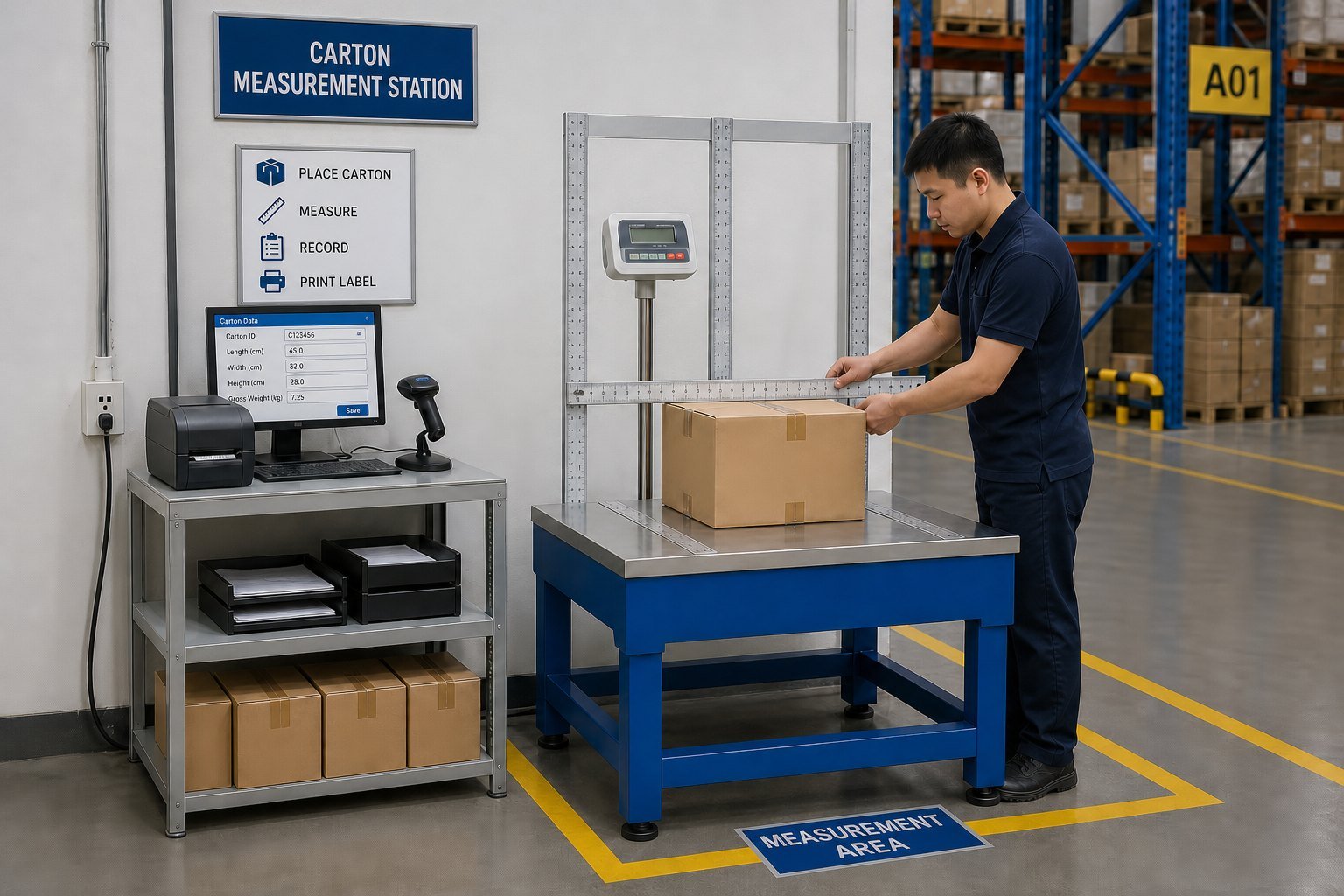
How to Measure Every Carton Correctly
Courier billing is based on the dimensions and weight of each individual carton, not only the shipment total.
- Seal the carton and place it on a level surface.
- Record the longest side as length, the second-longest as width and the remaining side as height.
- Measure the widest external points, including bulges, corner protectors and protrusions.
- Weigh the final packed carton and follow the carrier’s rounding rules.
Length Plus Girth
UPS and FedEx use length plus girth to assess large or oversize parcels:
Length plus girth = length + (2 x width) + (2 x height)
For a carton measuring 100 x 60 x 50 cm, the result is:
100 + (2 x 60) + (2 x 50) = 320 cm
That carton is below UPS’s 400 cm maximum, but it exceeds the UPS Large Package threshold of 300 cm. For FedEx, it exceeds the 266 cm Additional Handling threshold but remains below the 330 cm Oversize threshold, although volume and other criteria may still apply.
Chargeable Weight and Volumetric Weight
Chargeable weight begins with the higher of the carton’s actual gross weight and its volumetric weight. The higher result is then rounded up under the applicable courier billing rule to produce the final billed chargeable weight.
A common international express volumetric-weight formula is:
Volumetric weight in kg = length x width x height in cm / 5,000
- For a result of 21 kg or less: round upward to the next 0.5 kg billing increment.
- For a result above 21 kg: round upward to the next full kilogram.
- Example 1 — lightweight but bulky carton: A 60 x 40 x 40 cm carton has a volumetric weight of 19.2 kg. Its actual gross weight is 12 kg, so the higher preliminary result is 19.2 kg. Because it is below 21 kg, the final billed chargeable weight is 19.5 kg.
- Example 2 — carton above the 21 kg breakpoint: A carton’s higher preliminary result is 22.3 kg. Because it is above 21 kg, the final billed chargeable weight is 23 kg, not 22.5 kg.
Each carton in a multi-carton shipment is assessed and rounded separately. E-Quicky confirms the divisor, billing increment and account-specific rule before issuing the final quotation.
E-Quicky DHL Channel Size, Weight and Handling Rules
The following figures come from the DHL channel notice supplied by E-Quicky for quotation and booking screening. They are channel-specific and may differ from DHL’s public rate guide or another customer’s account.
The supplied channel notice identifies these operational triggers:
- Difficult handling: actual weight is from 24 kg to 69 kg, or the piece uses irregular packaging. The base surcharge is RMB 165 per piece, with the applicable monthly fuel surcharge added.
- Oversize: the longest side exceeds 90 cm or the second-longest side is 78 cm or longer. The base surcharge is RMB 165 per piece, with the applicable monthly fuel surcharge added.
- Overweight: billable weight is 69 kg or more. The base surcharge is RMB 875 per piece, with the applicable monthly fuel surcharge added.
- Non-cumulative rule: when a piece meets more than one of these conditions, the highest applicable surcharge is collected.
- Channel limits: billable weight cannot exceed 300 kg per piece or 1,999 kg per shipment, and cargo higher than 160 cm is not accepted through this channel.
Irregular packaging includes pieces not fully enclosed in corrugated cardboard; metal, wood, plastic or foam outer packaging; shrink or stretch wrap; cylinders; exposed straps, handles or wheels; and pieces likely to disrupt sorting. Some routes accept wooden cases but not open wooden frames. Wooden cases above 21 kg need skids or feet. Confirm before pickup.
UPS Size and Weight Rules
UPS’s China guidance allows parcels up to 70 kg, 274 cm on the longest side and 400 cm in length plus girth. These are network ceilings, not surcharge-free targets.
UPS Additional Handling can apply when:
- the actual weight exceeds 25 kg;
- the longest side exceeds 122 cm;
- the second-longest side exceeds 76 cm;
- the parcel is not fully encased in corrugated cardboard; or
- the parcel is cylindrical or otherwise requires manual handling.
A UPS Large Package classification can apply when the longest side exceeds 243 cm or length plus girth exceeds 300 cm. A Large Package is subject to a minimum billable weight of 40 kg under the current China guidance.
A 250 cm-long carton remains below the 274 cm maximum but is already a Large Package. Parcels approaching either ceiling require destination, service and local-delivery checks before booking.
FedEx Size and Weight Rules
FedEx’s 2026 China surcharge guide treats a package as unauthorized when it exceeds 68 kg actual weight, 274 cm in length or 419 cm in length plus girth. An unauthorized package may be refused, returned to the shipper or otherwise handled under FedEx terms, even if FedEx elects to move it and applies an Unauthorized Package Charge.
For applicable China international services in 2026, FedEx Additional Handling — Dimension can apply when a package:
- exceeds 121 cm on the longest side;
- exceeds 76 cm on the second-longest side;
- exceeds 266 cm in length plus girth; or
- exceeds 169,901 cm³ in cubic volume.
Additional Handling — Weight can apply above 25 kg actual weight. FedEx Oversize treatment can apply above 243 cm in length, above 330 cm in length plus girth, above 50 kg actual weight or above 283,168 cm³ in volume. Under the published 2026 China guide, the listed base fees are CNY 195 per package for Additional Handling, CNY 516 for Oversize and CNY 2,025 for an Unauthorized Package, before any applicable fuel or demand surcharge.
The 2026 rules make accurate three-dimensional measurement essential. FedEx also applies packaging criteria to parcels that are not fully encased in corrugated fiberboard, are stretch-wrapped, cylindrical, banded, fitted with handles or likely to interfere with sorting equipment.
Which International Courier Should You Choose?
No carrier is the cheapest or fastest for every shipment. The decision should be based on the complete route.
| Shipping requirement | Practical selection approach |
|---|---|
| Urgent documents, samples or compact commercial parcels | Compare DHL Express Worldwide, UPS Worldwide Express or Saver, and FedEx International Priority using the exact postcode pair |
| North American business delivery | Compare UPS and FedEx first, then check DHL where its route or customs solution is stronger |
| Broad global destination coverage | Check DHL alongside UPS and FedEx; remote-area and delivery-service availability can change the final result |
| Large but still parcel-sized cartons | Compare the carrier’s special-handling, large-package, oversize and minimum-billable-weight rules before comparing the base rate |
| Multiple cartons | Rate every carton separately, then compare the shipment total, pickup conditions, customs process and delivery commitment |
| Battery-powered products or dangerous goods | Confirm commodity acceptance and documents before selecting the carrier or printing labels |
E-Quicky compares the carton profile, cargo description, route, service availability and customs requirements—not only the base rate.
Packing Rules That Prevent Rebilling and Damage
The carrier measures the package it receives, not the supplier’s estimated dimensions.
- Use a rigid, undamaged corrugated carton suitable for the gross weight.
- Keep the outer surface rectangular and fully enclosed.
- Prevent bulging by using the correct carton size and adequate internal support.
- Protect fragile goods with internal cushioning and separation, not only external warning stickers.
- Seal the centre seam and both edge seams with pressure-sensitive tape using an H-taping method.
- Remove old labels, barcodes and routing marks.
- Avoid loose stretch wrap, exposed straps, wheels, handles or protruding parts on ordinary parcel shipments.
- Apply one clear shipping label to the largest flat surface and keep a duplicate document pouch when required.
- Photograph every sealed carton with its label, dimensions and scale reading before pickup.

Documents for International Express Shipping from China
Most commercial express shipments require more than a courier label.
Commercial Invoice
The commercial invoice should identify the seller, buyer, consignee, detailed product name, material, use, quantity, unit value, total value, currency, Incoterm, country of origin and reason for export. Descriptions such as “parts,” “sample,” “accessories” or “gift” are not sufficient for reliable customs review.
Packing and Parcel Data
For multiple cartons, provide a breakdown of contents, gross weight and dimensions for every piece. Booking data must match the cargo presented at pickup.
Customs and Receiver Information
Prepare the HS code, value, origin, address, receiver details and destination tax or importer number. Confirm who will pay duties and taxes.
Product-Specific Documents
Some goods require licences, conformity documents, safety data, brand authorisation or other supporting information. Battery-powered products, standalone batteries, liquids, powders, magnets, aerosols, chemicals and medical products must be disclosed before booking.
Batteries and Dangerous Goods Are Not Ordinary Express Parcels
DHL, UPS and FedEx can accept selected regulated goods through approved channels, subject to commodity, classification, battery configuration, watt-hour rating, quantity, packaging, route and account authorisation.
For lithium-battery cargo, the review may require a UN 38.3 test summary, SDS or MSDS, battery specification, product photographs, package photographs and a dangerous-goods declaration when applicable. A product with a battery installed is still regulated cargo even when the battery is below 100 Wh.
Do not send cartons to the warehouse before acceptance is confirmed. Misdeclared batteries or dangerous goods can be rejected, returned or delayed.
International Express Quote Checklist
Provide the following information for a meaningful DHL, UPS or FedEx quotation:
- pickup city and complete supplier address;
- destination country, postcode and complete delivery address;
- detailed product name, material and use;
- number of cartons;
- final gross weight and external dimensions of every carton;
- commercial value, currency and Incoterm;
- preferred delivery speed or required arrival date;
- HS code and country of origin, if available;
- battery, liquid, powder, magnet or dangerous-goods information;
- available invoices, packing lists, specifications, test reports and photographs; and
- receiver’s customs-clearance capability and tax-registration details where required.
The final delivery address matters: remote-area, residential and local size restrictions can change both cost and carrier availability.
Common Mistakes That Increase International Courier Costs
- Comparing only the price per kilogram without checking volumetric weight.
- Reporting one total shipment weight instead of the weight of every carton.
- Using factory carton dimensions before the final cartons are sealed.
- Assuming the maximum accepted weight is free from special-handling charges.
- Ignoring length plus girth and cubic-volume thresholds.
- Wrapping an ordinary parcel in stretch film or leaving straps and handles exposed.
- Describing products too generally for customs and carrier screening.
- Failing to disclose batteries, liquids, powders or other regulated components.
- Choosing a carrier before confirming delivery to the final postcode.
- Treating a previous shipment as proof that a new product, carton or route will be accepted identically.
Frequently Asked Questions
Is 70 kg the maximum weight for every international courier carton?
No. E-Quicky’s DHL channel notice states a 300 kg billable-weight cap per piece but applies surcharges from lower thresholds. UPS uses a 70 kg ceiling, while FedEx applies Unauthorized Package criteria above 68 kg actual weight. These figures are not equivalent acceptance promises.
Can DHL, UPS or FedEx accept a carton longer than its standard dimensions?
Sometimes, but it may require a freight product, special booking, manual handling, a different account channel or repacking. Acceptance also depends on the origin, destination and aircraft or vehicle network.
Which carrier has the lowest volumetric weight?
There is no permanent winner. The divisor, rounding method, minimum billable weight, surcharge rules and account rate all affect the result. Compare the final packed carton through the intended service.
Which courier is best for shipping from China to the United States or Europe?
UPS and FedEx are often strong candidates for North America, while DHL is frequently competitive across a broad international network. For Europe, all three should be compared using the destination postcode and parcel profile. The correct answer is route-specific.
Must every carton have its own weight and dimensions?
Yes. Each piece can trigger dimensional weight, Additional Handling, Large Package, Oversize or Non-Conveyable treatment independently. Accurate carton-level data is essential.
Can E-Quicky ship battery-powered products by international express?
E-Quicky can review approved DHL, UPS, FedEx or specialist express channels for eligible battery-powered products, including batteries at or below 100 Wh and selected batteries above 100 Wh. The final carrier, packaging and delivery service depend on the product, battery data, documents and destination.
Plan Your International Express Shipment with E-Quicky
The best international courier is not simply the carrier with the lowest base rate. A reliable shipment begins with correct carton data, a complete product description, destination customs information and an acceptance check against the current service rules.
For service coverage, route planning and quotation support, review E-Quicky’s international express shipping service from China.
Send E-Quicky the pickup address, final delivery postcode, product details, carton count, weight, dimensions and available documents. We will compare suitable DHL, UPS, FedEx or specialist express options and prepare a quotation based on the cargo that will actually be shipped. Contact E-Quicky for an international express route review.