
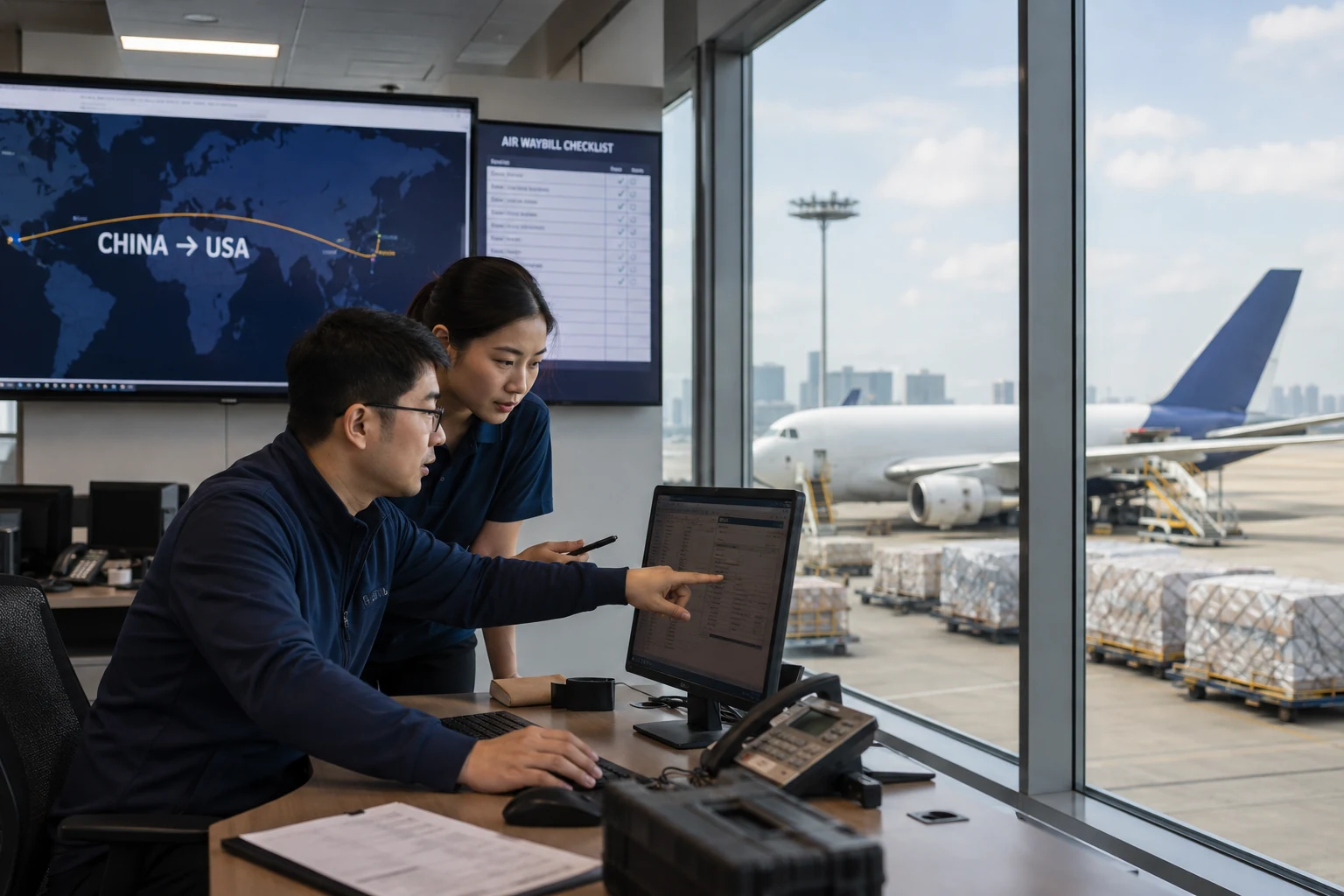
Planning air freight from China to the USA starts with the cargo, the factory location and the final delivery address. Compare the departure airport, airline, U.S. gateway, customs broker and onward transport as one complete route.
Mainland China and Hong Kong both offer strong departure options, but their export and airline-acceptance processes differ. A nearby mainland hub may suit general cargo, while Hong Kong can add carrier choice and flexibility for selected battery-powered products and dangerous goods.
This guide covers the principal U.S. cargo airports, mainland and Hong Kong routing, shipping documents, chargeable weight, customs preparation and quotation requirements.
How Air Freight from China to the USA Works
Air freight is normally chosen for high-value, urgent or supply-critical cargo such as production components, electronics, medical equipment, replacement parts, samples and inventory replenishment. It is faster than ocean freight, but acceptance is stricter and cost is sensitive to weight, dimensions, routing and classification.
A complete service can include factory pickup, consolidation, export declaration, security screening, terminal handling, airline booking, U.S. customs clearance and final delivery. Flight time alone is not door-to-door transit time; cut-offs, connections, customs examinations and delivery appointments also matter. Clearance and delivery arrangements depend on the agreed service scope and the appointed destination partners.
Major U.S. Airports for Air Cargo from China and Hong Kong
The best U.S. airport is not always the nearest one. Capacity, schedules, cargo-terminal capability, customs arrangements and domestic trucking all affect the result. The 2025 ACI-NA cargo rankings place several gateways below among North America’s leaders.
| U.S. gateway | Practical use | Common delivery region |
|---|---|---|
| Los Angeles (LAX) | Major trans-Pacific gateway with broad passenger and freighter capacity | Southern California, Arizona, Nevada and Western U.S. distribution |
| Chicago O’Hare (ORD) | Large international cargo hub with strong Asia links and central geography | Midwest, Great Lakes and nationwide trucking connections |
| New York John F. Kennedy (JFK) | Primary international gateway for the New York region and high-value cargo | New York, New Jersey and the Northeastern U.S. |
| Dallas/Fort Worth (DFW) | Central U.S. gateway with extensive onward road and air connections | Texas, South Central U.S. and selected Latin America connections |
| Miami (MIA) | Major international cargo and perishables gateway | Florida, Southeastern U.S., Latin America and the Caribbean |
| San Francisco (SFO) | Important passenger-belly gateway for technology and high-value traffic | Northern California and the San Francisco Bay Area |
| Anchorage (ANC) | Leading trans-Pacific technical and cargo transfer point | Usually an airline network hub rather than the final delivery airport |
Los Angeles International Airport (LAX)
LAX is a primary comparison for West Coast cargo. It supports large trans-Pacific flows and serves Southern California, but terminal handling, congestion and truck appointments must be included in the plan.
Chicago O’Hare International Airport (ORD)
ORD combines international cargo capacity with central geography. It is a practical gateway to compare for Midwest consignees when it reduces inland trucking compared with a coastal airport.
John F. Kennedy International Airport (JFK)
JFK serves New York and the Northeast. It suits urgent commercial and high-value cargo, although terminal availability, local traffic and customs arrangements require advance planning.
Dallas/Fort Worth International Airport (DFW)
DFW supports Texas and central U.S. distribution through strong road and air connections. It may also suit Asia–Latin America traffic when schedules and customs arrangements align.
Miami International Airport (MIA)
MIA is a gateway to compare for Florida, the Southeast and onward Latin American distribution. Confirm the available connections and handling arrangements for the shipment date instead of assuming a direct flight from China.
San Francisco International Airport (SFO)
SFO is an important Bay Area gateway for technology, medical and high-value cargo. Compare it with LAX because belly capacity, piece dimensions and weekly schedules affect the total route.
Anchorage and the U.S. Integrator Hubs
Anchorage is a key trans-Pacific transfer point but is usually an airline-selected hub, not the importer’s final airport. Memphis (MEM), Louisville (SDF) and Cincinnati/Northern Kentucky (CVG) are also major express-network hubs. General air freight normally uses the destination gateway offering the best balance of capacity and inland delivery.
Mainland China or Hong Kong: Which Departure Is Better?
Neither channel is universally faster or cheaper. The comparison should be made after the product, packaging, documents, factory location and U.S. destination are known.
| Planning factor | Mainland China departure | Hong Kong departure |
|---|---|---|
| Typical gateways | PVG, SZX, CAN, PEK/PKX, CGO and other regional hubs | Hong Kong International Airport (HKG) |
| Best fit | General cargo and approved special cargo located near a mainland gateway | Shipments benefiting from HKG’s airline network or specialist acceptance options |
| Origin transport | Direct domestic pickup to the export airport or consolidation warehouse | Cross-border movement to Hong Kong before airport tender |
| Main advantage | Shorter origin leg, multiple regional airports and competitive general-cargo capacity | Dense international cargo network and additional routing flexibility |
| Important limitation | Acceptance documents and airline options can vary by airport and cargo type | Cross-border handling adds time, cost and an additional compliance stage |
Advantages of Air Freight from Mainland China
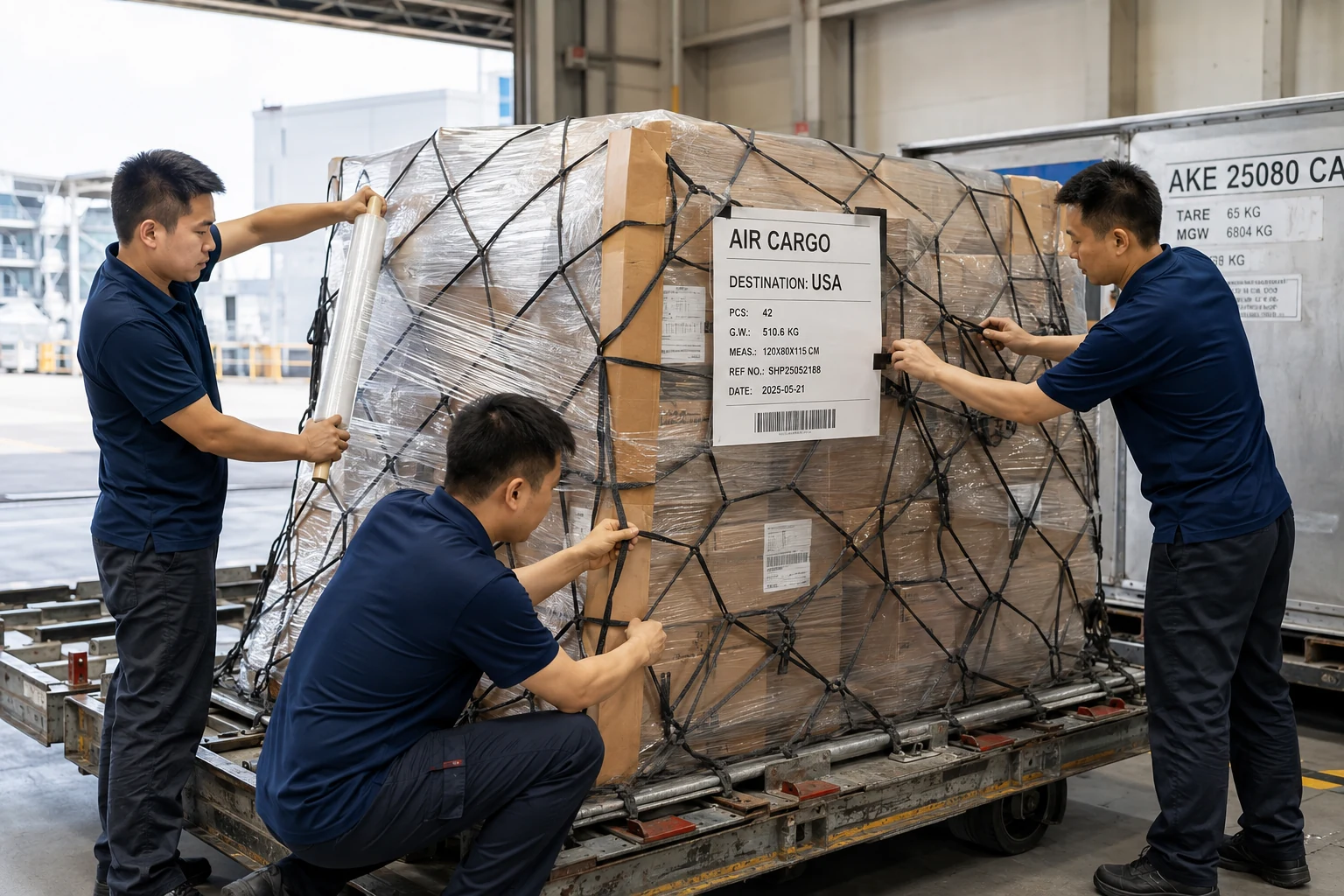
A nearby mainland airport can minimize origin trucking and handling. Shanghai Pudong (PVG), Shenzhen (SZX), Guangzhou (CAN), Beijing (PEK/PKX) and Zhengzhou (CGO) offer different mixes of direct flights, freighter capacity and connections.
Mainland departure often suits correctly described general cargo and approved special cargo. It avoids a Hong Kong cross-border transfer, but any rate advantage can disappear when the selected airport has limited acceptance or requires a long connection.
Advantages of Air Freight from Hong Kong
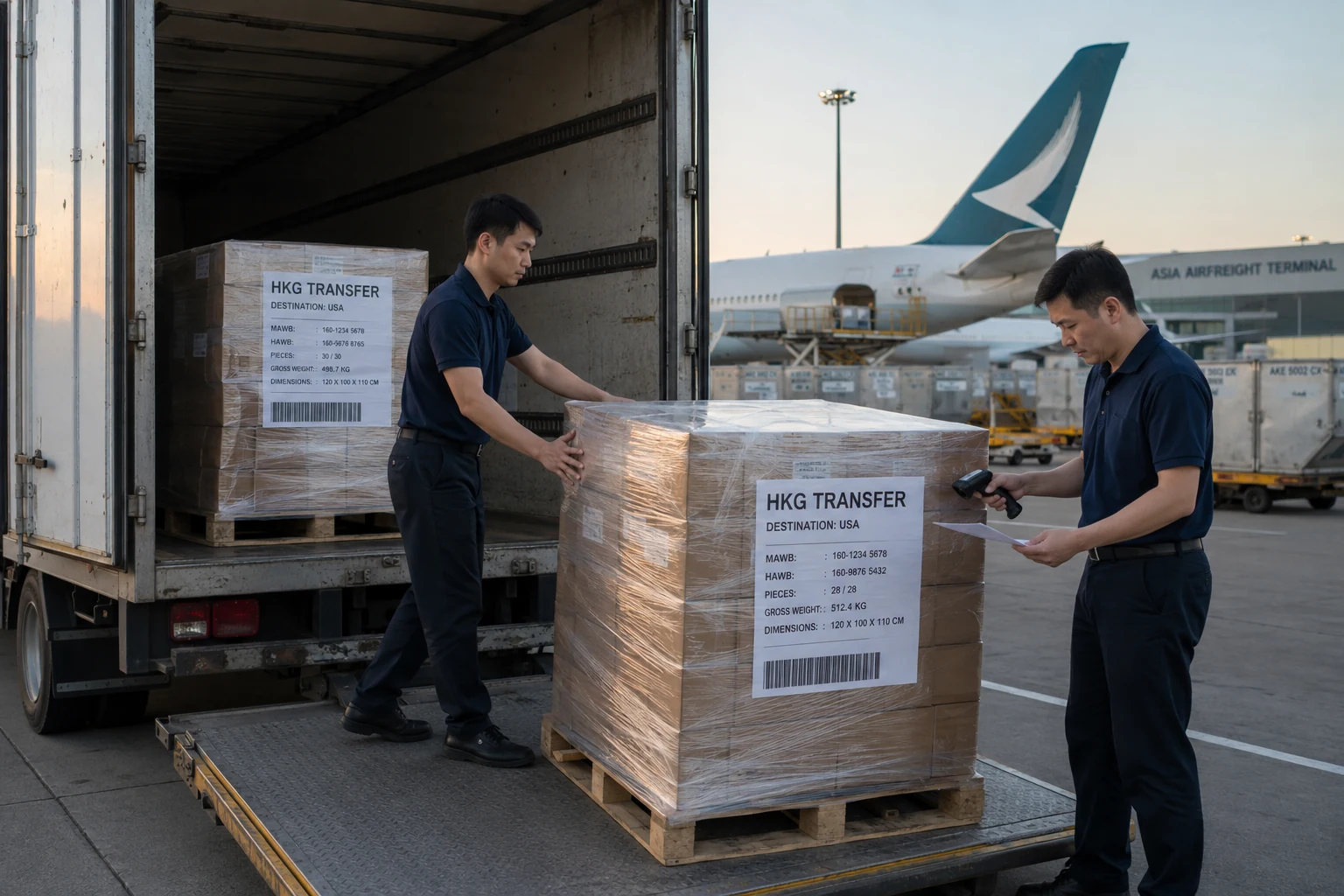
Hong Kong International Airport handled 5.1 million tonnes of cargo in 2025/26 and connects more than 220 destinations through around 140 airlines. This network provides broad carrier and routing choice.
HKG can help South China factories when its schedules or specialist acceptance options outperform a mainland route. E-Quicky can arrange cross-border transfer and review battery-powered products at or below 100 Wh and above 100 Wh, subject to classification, packaging, documents and airline approval.
Hong Kong is not a compliance shortcut. Cargo must still meet Hong Kong, ICAO/IATA, terminal and airline requirements, and the cross-border leg needs sufficient time.
Cargo Classification Comes Before the Route
First establish whether the goods are regulated for air transport. Battery-powered products are discussed separately below because they need specific checks; they can also be dangerous goods and are not a mutually exclusive cargo category.
General Cargo
General cargo is cargo that is not classified as dangerous goods under the applicable transport rules. Textiles, non-powered hardware and ordinary spare parts may qualify after checking for hidden hazards such as batteries, aerosols, chemical residues or magnetized components.
The invoice must still state what the product is, what it is made from and how it is used. “Parts,” “accessories,” “samples” and “electronics” are too vague for reliable screening.
Battery-Powered Products
Check chemistry, model, capacity, quantity and whether batteries are separate, packed with equipment or installed. Lithium-ion cells of 20 Wh or less and batteries of 100 Wh or less may qualify for specific provisions; these ratings do not make cargo unregulated. Lithium-metal batteries use lithium-content criteria. Power banks are batteries, not equipment containing batteries.
Make the applicable UN 38.3 test summary available. Confirm the correct packing instruction, short-circuit protection, marks, labels, declaration and state-of-charge requirements. Battery-powered vehicles need separate classification. Refer to IATA’s 2026 battery guidance, including its documentation section.
An SDS may be requested for acceptance review; it is not a universal battery transport document mandated by IATA. It cannot replace the test summary or required shipping declaration.
For mainland departure, confirm any transport identification report and export packaging inspection requirements with the responsible customs office and acceptance channel. Do not use 100 Wh alone to decide whether a Dangerous Package Certificate is needed. Hong Kong departure also requires route-specific acceptance. See our battery shipping service for the information needed to request a review.
Dangerous Goods
Dangerous goods are classified by the hazards they present during transport. The following nine classes are an overview, not a list of services available on every E-Quicky route. See the PHMSA hazard-class definitions; exact classification depends on the product and its properties.
- Class 1 — Explosives: fireworks, ammunition and selected pyrotechnic devices.
- Class 2 — Gases: aerosols, gas cartridges, compressed gas cylinders and some refrigerants.
- Class 3 — Flammable liquids: paint, ink, perfume, alcohol solutions, fuel additives and many adhesives.
- Class 4 — Flammable solids: matches, certain metal powders, self-heating substances and materials dangerous when wet.
- Class 5 — Oxidizers and organic peroxides: pool chemicals, bleaching agents and some curing compounds.
- Class 6 — Toxic and infectious substances: pesticides, laboratory toxins, clinical samples and selected medical specimens.
- Class 7 — Radioactive material: certain medical, industrial and measuring sources.
- Class 8 — Corrosives: acids, alkalis, wet batteries and some cleaning products.
- Class 9 — Miscellaneous dangerous goods: lithium batteries, sodium-ion batteries with organic electrolyte, dry ice, regulated magnetized material and certain environmentally hazardous substances.
Consumer products can also be dangerous goods. Common examples include power banks, e-bike batteries, drones, perfumes, nail polish, aerosol sprays, hand sanitizer, paint, adhesives, cleaning chemicals, refrigerant equipment and samples packed with dry ice. Classification depends on the exact formulation, concentration, battery configuration, quantity and packing method—not only the commercial product name.
SDS vs. MSDS: What Is the Difference?
MSDS (Material Safety Data Sheet) is the older term; SDS (Safety Data Sheet) is the current term used with the GHS framework. The familiar 16-section layout organizes identity, hazards, handling and other safety information. They are not two separate transport certificates. Check the document contents, revision and product match rather than relying only on its title. OSHA Appendix D specifies its mandatory sections and treats sections 12–15, including transport information, as non-mandatory under that standard.
For chemicals, obtain the manufacturer or responsible supplier’s current SDS for the exact formulation. Use English where U.S. requirements apply. Section 14, when provided, is useful input for transport review, but an SDS is not a transport approval. Confirm classification against the actual product, quantity, packing and applicable transport rules. An old MSDS should not be assumed acceptable merely because its filename has been changed to SDS.
Documents Required for Dangerous Goods Review
Start with the commercial and product information below. The shipper or qualified dangerous-goods specialist then identifies the documents required for that classification and route; not every item in this checklist is mandatory for every product.
- Commercial documents: commercial invoice, packing list, detailed product description, intended use, HS/HTS code, shipper, consignee and Incoterm.
- Classification evidence: product composition or technical specification, current SDS where applicable, UN number, proper shipping name, class or division, subsidiary risk, packing group if assigned, and dangerous-goods quantity per package. Additional properties such as flash point may be needed for classification.
- Packaging evidence: package type, UN packaging specification where required, inner and outer quantities, closure method, absorbent or cushioning details, package dimensions, gross weight, and clear photographs of the product, inner packing, closed outer carton, marks and labels.
- Transport documents: Air Waybill instructions and, for most fully regulated air shipments, a correctly completed Shipper’s Declaration for Dangerous Goods signed by a trained and authorized person.
- Product-specific evidence: applicable battery test summary and specifications; chemical composition and test data; biological-material classification where relevant; dry-ice weight and packaging information; and any required permits or competent-authority approvals. Requirements differ by product.
- Origin and carrier acceptance: Air Transport Conditions Identification Report or export packaging documentation when required by the mainland China acceptance channel, plus airline pre-approval for restricted commodities.
Damaged, defective, recalled, waste or prototype batteries require specialist review and may be prohibited from air transport. E-Quicky confirms the route only after the actual model, documents, packing and carrier acceptance have been checked.
Document Checklist for U.S. Air Freight
| Document or data | General cargo | Battery-powered products | Dangerous goods |
|---|---|---|---|
| Commercial invoice and packing list | Required | Required | Required |
| Detailed description, use and HTS code | Required | Required | Required |
| Air Waybill instructions | Required | Required | Required |
| Technical specification and photographs | When needed | Required | Required when applicable |
| UN 38.3 test summary | Not applicable unless relevant batteries are present | Make available for applicable battery types; check exceptions | Battery-specific, not a general DG certificate |
| Current SDS / product safety information | Not normally required | May be requested for review; not universally required by IATA | Applicable chemicals / acceptance review; not required for every article |
| Air Transport Conditions Identification Report | Not normally required | May be required for mainland acceptance | As required by the acceptance channel |
| Dangerous Package Certificate | Not applicable | Check mainland export packaging rules and applicable exemptions | Required where applicable |
| Dangerous Goods Declaration | No | When required by classification | Required unless a specific provision removes it |
| Carrier acceptance, marks and labels | Standard handling | Battery- and route-specific | Required as applicable |
U.S. Customs Clearance Requirements
The U.S. importer and customs broker should be ready before departure. The commercial invoice must identify the seller, buyer, consignee, detailed product description, quantity, unit value, total value, currency, Incoterm and country of origin. The packing list should show every package, gross and net weight, and final dimensions.
The importer or broker uses the appropriate Harmonized Tariff Schedule code and provides the customs entry data. U.S. Customs and Border Protection explains when a customs bond is required, including many formal commercial entries. Product-specific approvals may be required by the FDA, FCC, EPA, USDA, CPSC or another agency.
Confirm who will act as importer of record, who will appoint the broker, and who will pay duties and taxes. The Air Waybill consignee and the importer of record are not automatically the same party. Also note that the ocean-freight ISF “10+2” filing is not the standard filing for an air shipment.
U.S. Import Clearance: Who Does What?
- Prepare: the importer supplies the commercial invoice, packing list, shipment details and any product-specific permits to the appointed broker.
- File: the importer or licensed customs broker files the appropriate entry information. Using a broker does not transfer the importer’s responsibility for accuracy.
- Review and release: CBP and any other relevant agencies review the entry and may request documents or an examination.
- Arrange delivery: coordinate pickup only after the applicable customs and terminal release requirements are satisfied.
Process overview; individual shipments may follow different entry procedures. Read CBP’s guidance for importers.
How Chargeable Weight Is Calculated
Air freight is rated on chargeable weight: the higher of actual gross weight and volumetric weight. A commonly used air-freight formula is:
Volumetric weight in kg = length × width × height in cm ÷ 6,000
For example, a pallet measuring 120 × 100 × 90 cm has a volumetric weight of 180 kg. If its actual gross weight is 140 kg, the preliminary chargeable weight is 180 kg. If the same pallet weighs 220 kg, the preliminary chargeable weight is 220 kg. The airline or consolidation channel may use a different divisor, minimum charge or rounding rule, so E-Quicky confirms the applicable method before issuing the final quotation.
Piece dimensions also matter independently of weight. Oversized cargo may not fit a passenger aircraft’s lower deck and can require a freighter, special equipment or a different gateway.
Typical Transit Time from China to the USA
After documents and airline acceptance are complete, a direct airport-to-airport movement may operate in roughly two to five days. Consolidated or connecting service may take about four to eight days. Door-to-door transport may require approximately six to twelve days after cargo readiness.
These are planning ranges, not guarantees. Capacity, flight changes, dangerous-goods approval, export processing, customs examination, weather, peak season and the final U.S. delivery address can change the result. A slower route with confirmed acceptance can be more reliable than a nominally faster flight that has not approved the cargo.
Air Freight Quote Checklist
Provide the following information for a useful China-to-USA air freight quotation:
- supplier name, pickup city, complete address and cargo-ready date;
- final U.S. delivery address, ZIP code and preferred arrival airport, if any;
- detailed product name, material, use and HTS code;
- product description and any batteries or other potentially regulated components;
- package count, packaging type, final gross weight and dimensions of every piece;
- commercial value, currency, Incoterm and required service scope;
- for batteries: chemistry, model, voltage, capacity, watt-hour rating, quantity and configuration;
- for dangerous goods: confirmed classification, package quantities and available safety information;
- available reports, certificates, declarations and clear product or packing photographs; and
- U.S. importer of record, customs broker and tax-and-duty payment arrangement.
Common Mistakes That Delay U.S. Air Freight
- Choosing an airport before checking the final delivery cost and cargo acceptance.
- Describing goods only as “parts,” “accessories,” “electronics” or “samples.”
- Failing to disclose batteries, liquids, powders, aerosols, magnets or other regulated components.
- Providing a UN 38.3 summary, SDS or identification report for a different battery model.
- Assuming a small lithium battery can be shipped as ordinary unregulated cargo.
- Assuming mainland China and Hong Kong require the same export and acceptance documents.
- Using estimated carton dimensions that change after booking.
- Delivering dangerous goods before airline pre-approval.
- Leaving the U.S. importer, broker or government-agency requirements unresolved until arrival.
- Comparing freight rates without comparing the complete pickup-to-delivery route.
Frequently Asked Questions
Is mainland China or Hong Kong faster for U.S. air freight?
Mainland China may be faster when a nearby airport accepts the cargo. Hong Kong may be faster when its network provides a better approved option. The answer depends on the shipment and current capacity.
Which U.S. airport is best for cargo from China?
LAX is often strong for the West Coast, ORD for the Midwest, JFK for the Northeast, DFW for Texas and central distribution, and MIA for Florida or Latin American connections. The best gateway is the one that produces the strongest total route after capacity, customs, terminal handling and domestic delivery are compared.
Can batteries fly from Hong Kong to the USA?
Eligible battery-powered products and batteries can be reviewed for Hong Kong departure, including products with batteries at or below 100 Wh and above 100 Wh. Packaging, declarations, state-of-charge controls, airline approval and route availability depend on the exact classification. Acceptance is not automatic.
What documents are needed for ordinary air cargo to the USA?
Most shipments need a commercial invoice, packing list, Air Waybill instructions, detailed product description, HTS code, export declaration data and U.S. importer information. Regulated products may require permits, conformity documents or another government agency’s approval.
Does E-Quicky provide door-to-door air freight to the USA?
Door-to-door service can be arranged for eligible cargo and destinations, subject to the agreed Incoterm, U.S. importer and customs setup, cargo classification and local delivery restrictions. Dangerous goods, oversized pieces and remote locations require separate confirmation.
Plan Your Air Freight Shipment to the USA
A reliable U.S. air-freight plan begins with accurate cargo classification and complete information. The departure airport, airline, U.S. gateway and delivery route should be selected together—not one at a time after the booking.
Send E-Quicky the product details, package data, origin, U.S. delivery address and available documents. We will compare suitable mainland China and Hong Kong departure options, review the destination gateway and prepare a route-specific quotation based on the cargo that will actually be shipped. Contact E-Quicky for a China-to-USA air freight route review.
Images are AI-generated illustrations of logistics workflows; they do not depict an actual customer shipment or customs approval.