
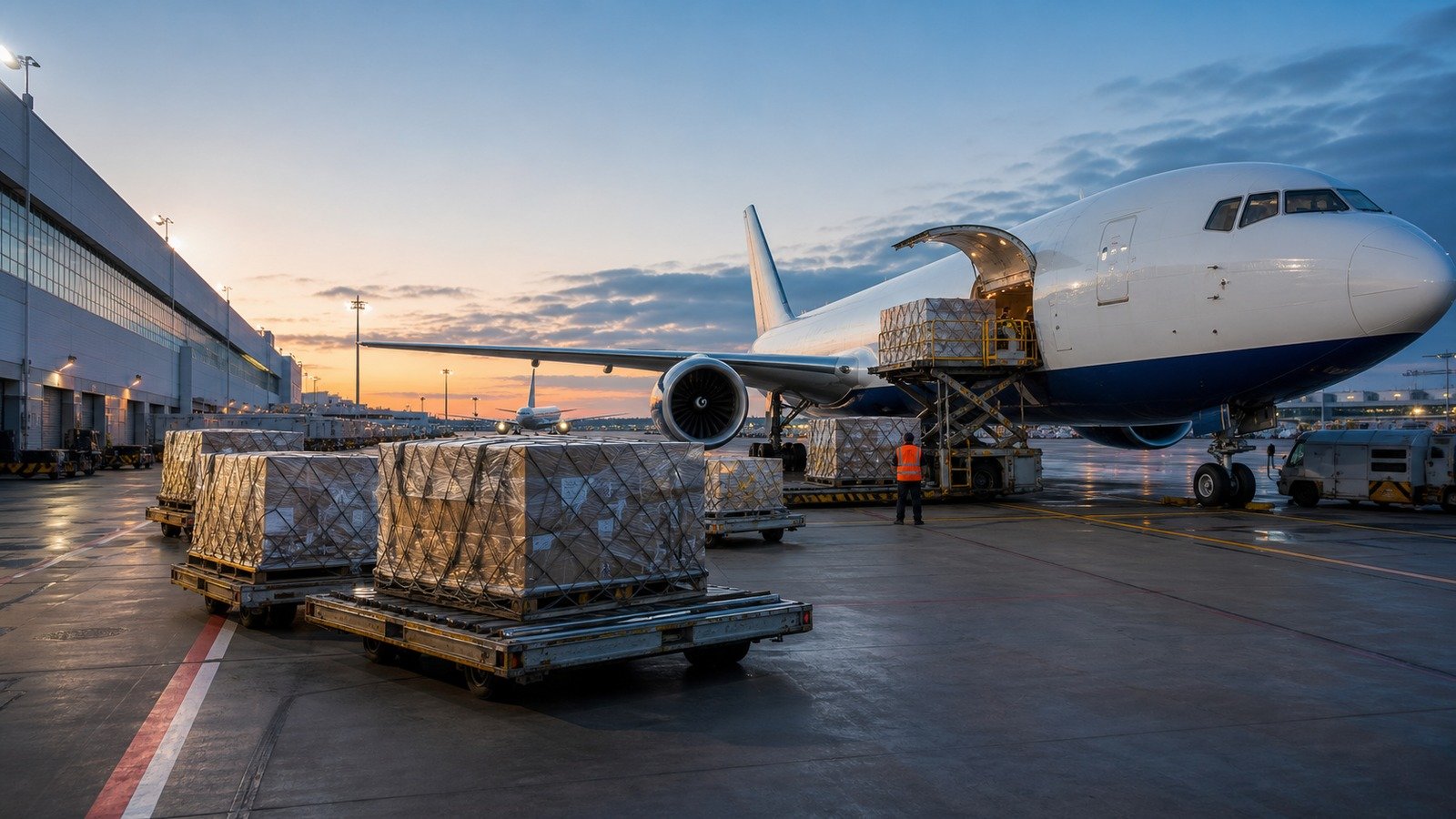
Air freight from China to the UK is the practical choice when cargo value, production deadlines or inventory shortages matter more than the lowest possible freight cost. It is not one standard service: ordinary machinery parts, electronics containing lithium batteries and regulated chemicals follow different acceptance processes.
Mainland China offers a broad choice of gateways, while Hong Kong can provide a valuable alternative for battery-powered products and specialist cargo. In the UK, the best arrival airport depends on capacity, cargo classification, final delivery address and customs arrangements—not simply distance from the consignee.
This guide explains how E-Quicky plans air freight from mainland China and Hong Kong to the United Kingdom, which UK cargo airports are commonly used, how cargo is divided into general cargo, battery-powered products and dangerous goods, and which documents should be prepared before a quotation is requested.
Why Use Air Freight from China to the UK?
Air freight is normally selected for time-sensitive, high-value or supply-critical shipments such as production components, electronics, medical devices, replacement parts, samples and urgent stock replenishment. It shortens the transport stage and supports smaller consignments that do not justify a full container, but costs more and imposes stricter controls on descriptions, dimensions, packaging, batteries and dangerous goods.
Flight time is not the complete door-to-door lead time. Collection, export declaration, security screening, terminal handling, airline acceptance, connections, UK customs clearance and final delivery must all be included.
Mainland China Departure or Hong Kong Departure?
Both channels can serve UK imports, but they are not interchangeable.
Air Freight from Mainland China
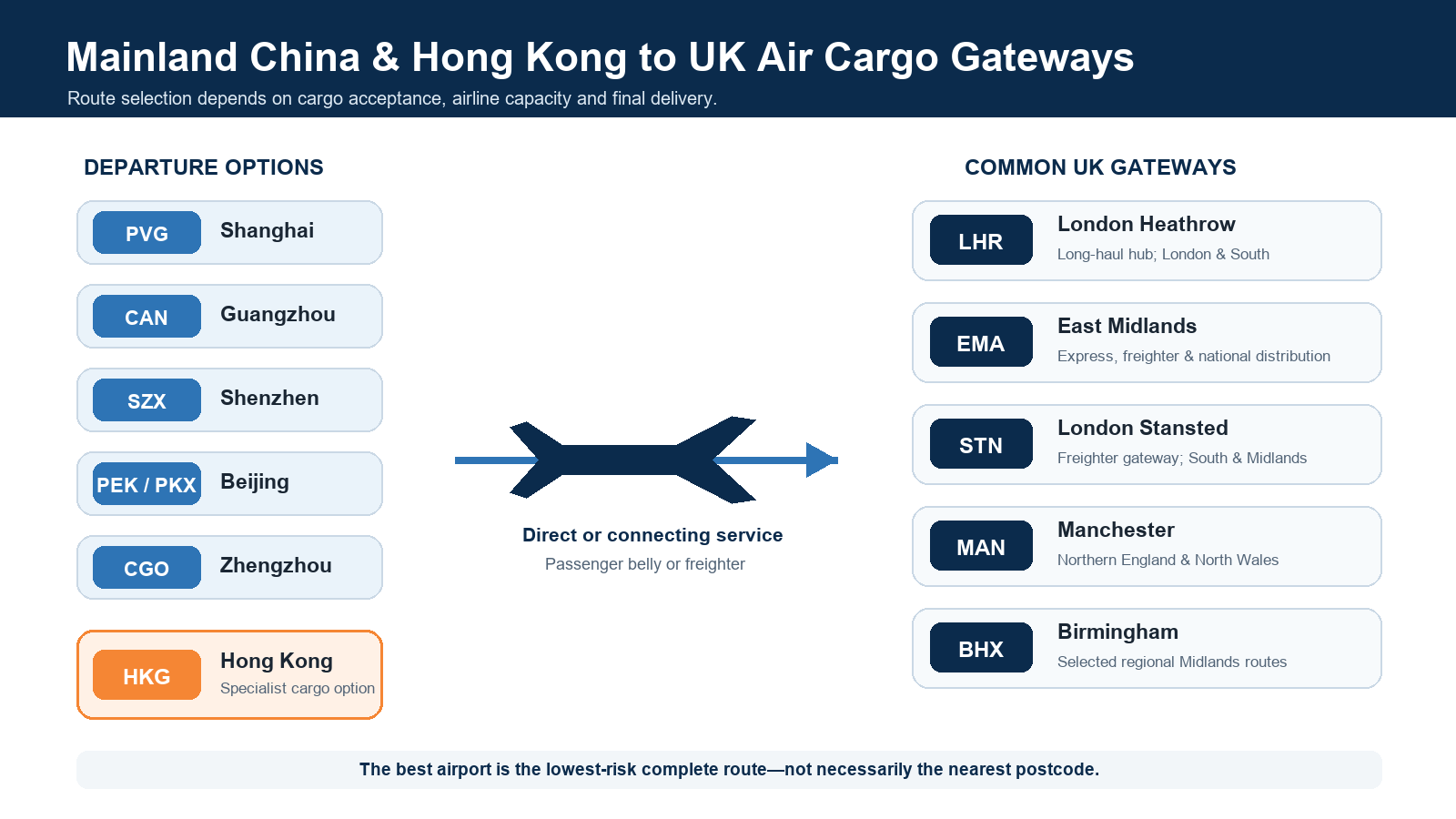
Common mainland gateways include Shanghai Pudong (PVG), Guangzhou Baiyun (CAN), Shenzhen Bao’an (SZX), Beijing Capital or Beijing Daxing (PEK/PKX), and Zhengzhou (CGO). Selection depends on factory location, capacity, cargo type and the UK gateway.
Mainland departure is often efficient for general cargo that already meets export and airline acceptance requirements. Battery-powered products and dangerous goods require earlier document screening. For lithium-battery cargo, the selected mainland airport, airline or acceptance channel will normally request an Air Transport Conditions Identification Report in addition to the product and battery documents. The report must match the actual model, battery configuration and packaging presented to the terminal.
Air Freight from Hong Kong
Hong Kong International Airport (HKG) is a major international cargo hub with extensive freighter and passenger-flight connectivity. Cargo from Southern China can move through an approved cross-border process and then be tendered under Hong Kong requirements.
Hong Kong is useful when its network, dangerous-goods facilities or battery acceptance options provide a better solution. It is not a way to bypass safety rules: batteries must still be classified, packed, marked, labelled and declared under current ICAO/IATA rules, Hong Kong requirements and airline variations.
Unlike a mainland departure, a mainland Air Transport Conditions Identification Report is not automatically the governing acceptance document in Hong Kong. The pre-booking file commonly includes the Air Waybill data, commercial invoice, packing list, UN 38.3 test summary, SDS or MSDS, battery specification, product and packaging details, and a Shipper’s Declaration for Dangerous Goods when the classification requires one. Additional documents may be requested by the carrier or terminal.
Major UK Airports for Air Cargo from China and Hong Kong
The arrival airport should be selected as part of the route plan. A flight into London may not be the best solution for a consignee in the Midlands or Northern England, while a freighter airport may offer better handling for dense, urgent or special cargo.
London Heathrow Airport (LHR)
Heathrow is the UK’s principal international hub and carries substantial freight on long-haul passenger aircraft. Its network suits direct capacity, high-value cargo, pharmaceuticals and Southern England, although belly capacity varies by schedule, aircraft and season.
East Midlands Airport (EMA)
East Midlands is the UK’s leading express air-freight hub and a major base for freighter and integrator operations. Its central location suits national distribution, the Midlands, e-commerce and time-critical cargo.
London Stansted Airport (STN)
Stansted supports a significant freighter community and road access to London, Southern England and the Midlands. It is practical for scheduled freighter cargo, larger pieces and shipments unsuited to passenger-aircraft belly capacity.
Manchester Airport (MAN)
Manchester’s World Freight Terminal handles freighter and passenger-flight cargo. It serves Northern England, North Wales and parts of the Midlands when the schedule and acceptance conditions are suitable.
Birmingham Airport (BHX)
Birmingham can be considered for the Midlands when capacity, handling and customs arrangements match the shipment. E-Quicky compares the complete route because EMA, LHR, STN or MAN may offer a stronger schedule.
Cargo Category 1: General Cargo
General cargo is non-restricted cargo without undeclared batteries, chemicals, compressed gas, flammable material, excessive magnetism or other regulated components. Examples include textiles, non-powered hardware, furniture components, packaging products and ordinary spare parts.
“General cargo” is not a substitute for an accurate product description. Descriptions such as “parts,” “accessories,” “sample” or “electronics” are too vague for airline and customs review. The invoice should state what the product is, what it is made from and what it is used for.
Documents for General Cargo
- Commercial invoice with seller, buyer, detailed product description, quantity, unit value, total value, currency, Incoterm and country of origin.
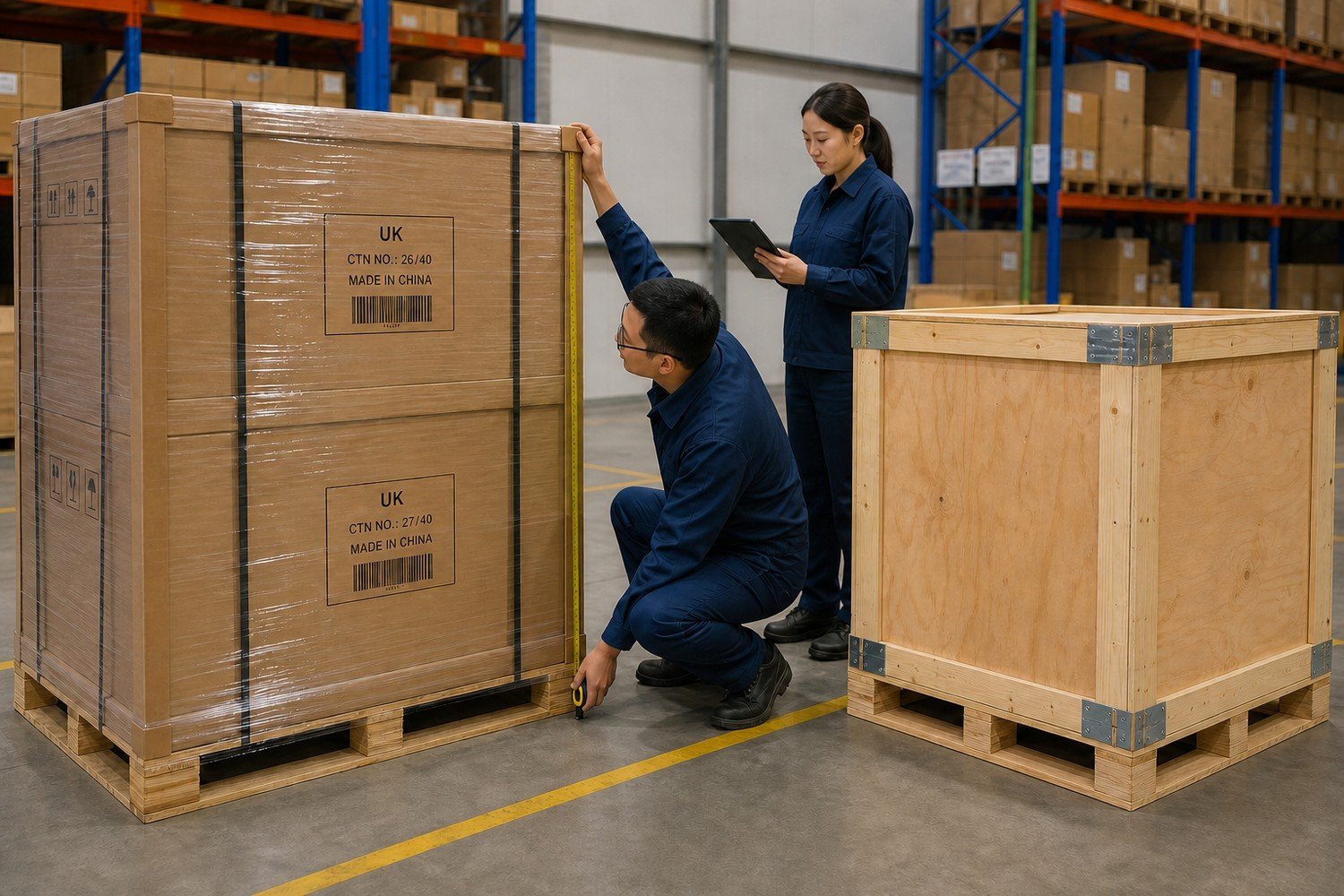
- Packing list showing package count, packaging type, net weight, gross weight and dimensions for every package.
- Air Waybill instructions with shipper, consignee, airport and handling information.
- Export customs declaration data, including the correct HS code and supporting licences or certificates when the commodity requires them.
- Product specification, photographs or material information when the description is not self-explanatory.
- Certificate of origin, conformity document or import licence when required by the product or the buyer’s UK customs procedure.
Wood packaging must meet applicable treatment and marking rules. Oversized, fragile, high-value and temperature-sensitive goods should be declared before booking because they may require special handling.
Cargo Category 2: Battery-Powered Products
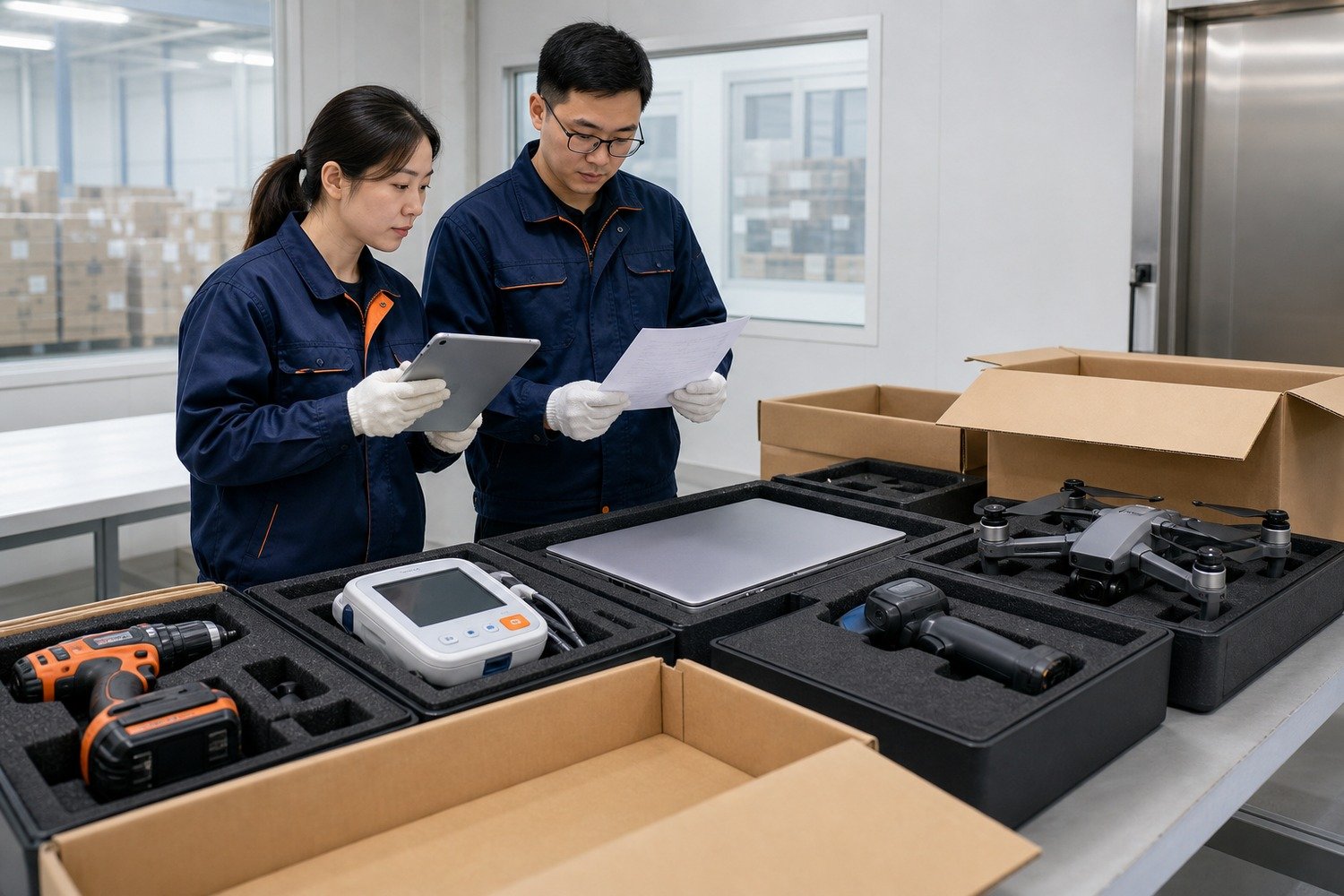
Battery-powered products include equipment with a battery installed or packed with it, such as laptops, tools, monitoring devices, medical equipment, e-bikes and drones. This commercial screening category does not place the cargo outside dangerous-goods rules. Lithium and sodium-ion batteries remain regulated even when a configuration qualifies for reduced requirements.
Classification depends on battery chemistry, configuration and watt-hour rating. The shipper must identify whether the battery is lithium ion, lithium metal, sodium ion or another chemistry; whether it is installed in equipment, packed with equipment or shipped separately; and whether each battery is at or below 100 Wh or above 100 Wh.
Core Documents for Battery-Powered Products
- UN 38.3 test summary that matches the battery cell or battery model used in the product.
- Current SDS or MSDS for the battery chemistry and product safety review.
- Battery specification showing chemistry, model, voltage, amp-hour capacity, watt-hour rating and battery weight.
- Product specification and clear photographs of the product, battery label, inner packaging and outer carton.
- Commercial invoice, packing list and Air Waybill details using consistent product and model descriptions.
- Shipper’s Declaration for Dangerous Goods when required by the applicable packing instruction and classification.
- Evidence of compliant packaging, marks and labels, plus airline pre-approval where required.
Mainland China Requirements for Battery-Powered Products
For a mainland China departure, prepare the Air Transport Conditions Identification Report required by the selected airport, airline or cargo acceptance channel. The report must cover the exact goods and packing configuration offered for transport; a report for a similar model should not be treated as interchangeable.
For E-Quicky’s mainland-China process, a battery exceeding 100 Wh also requires the Inspection Result Sheet for Use of Packaging for Outbound Dangerous Goods—commonly called the dangerous-goods packaging certificate—before booking. The final requirement depends on the classification, packaging and acceptance channel, but it should be identified at quotation stage rather than after the cargo reaches the airport. China Customs provides the applicable outbound dangerous-goods packaging inspection guidance.
The 100 Wh threshold also changes the applicable IATA packing section and package limits. In 2026, lithium-ion batteries packed with equipment are subject to reduced state-of-charge requirements, while a reduced state of charge is strongly recommended for batteries contained in equipment. The exact instruction must be confirmed against the product configuration, the current IATA battery guidance and the carrier rules.
Hong Kong Requirements for Battery-Powered Products
E-Quicky can arrange Hong Kong departures for battery-powered products with batteries at or below 100 Wh and for products with batteries above 100 Wh, subject to document review, compliant packaging, airline acceptance and route availability. The packaging, marks, labels, net battery limits and declaration requirements are not the same for the two groups.
Products above 100 Wh normally fall under the fully regulated provisions of the applicable packing instruction and may require UN specification packaging, a Shipper’s Declaration for Dangerous Goods, cargo-aircraft routing or other carrier controls. Products at or below 100 Wh may qualify for a less restrictive section, but they remain regulated and must still meet the applicable packing, short-circuit protection, marking and documentation rules.
Hong Kong acceptance follows current ICAO/IATA rules, Hong Kong Civil Aviation Department dangerous-goods requirements, terminal procedures and airline variations. A previous shipment does not prove that a new model or route will be accepted identically.
Cargo Category 3: Dangerous Goods
Dangerous goods present a risk to health, safety, property or the environment during air transport. Examples include certain chemicals, flammable liquids, aerosols, gases, corrosives, magnetised material, dry ice, machinery containing fuel, standalone batteries and fully regulated battery-powered equipment.
Classification—not the commercial name—is the starting point. The shipper must determine the UN number, proper shipping name, class or division, subsidiary risk, packing group and packing instruction. Damaged, defective, recalled, waste or prototype batteries require specialist review and may be prohibited.
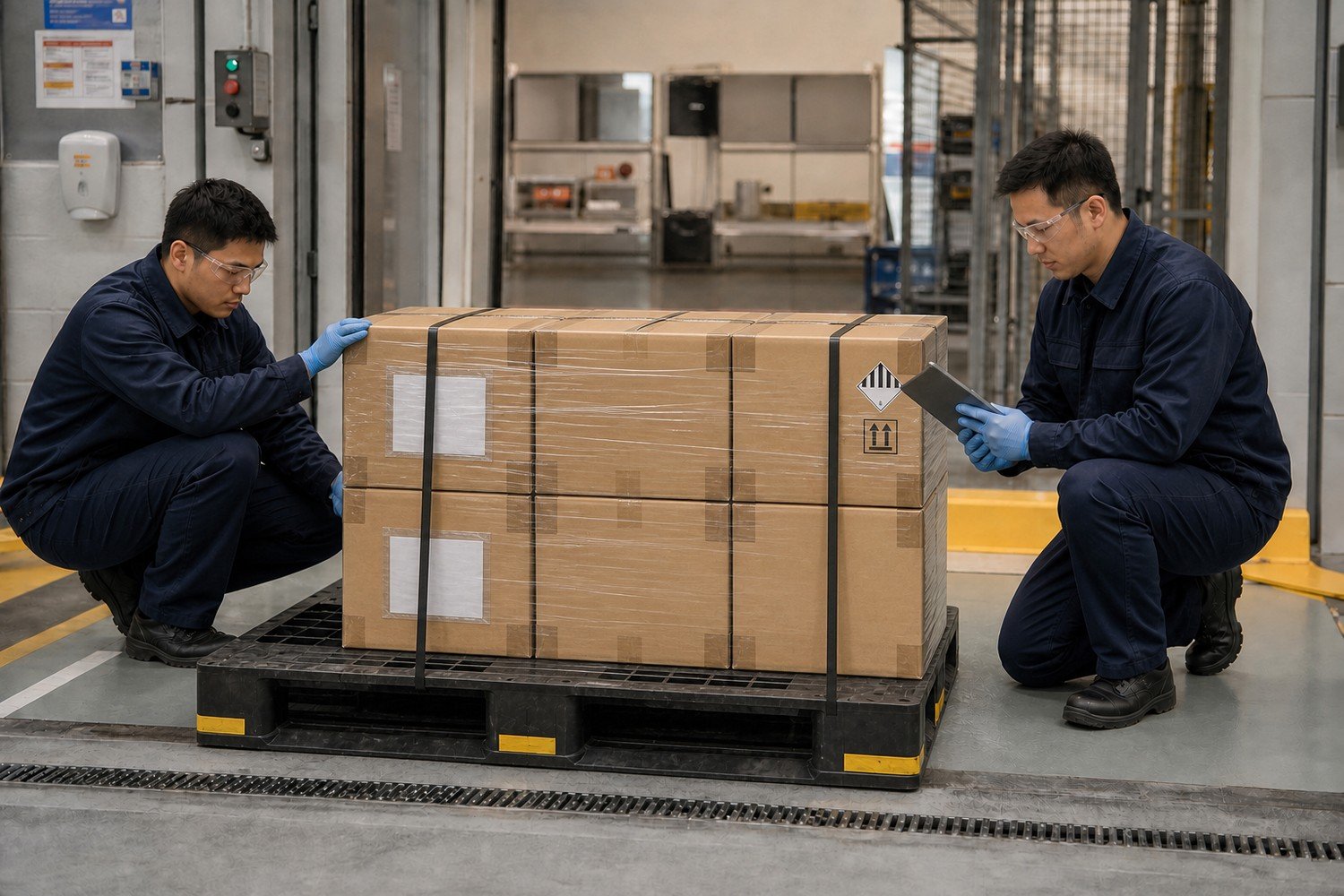
Documents for Dangerous Goods Air Freight
- Commercial invoice and packing list with descriptions consistent with the dangerous-goods documents.
- Current SDS containing transport information and the applicable classification data.
- Shipper’s Declaration for Dangerous Goods completed and signed by a trained, authorised person when required.
- UN number, proper shipping name, hazard class, subsidiary risk, packing group and packing instruction.
- Packaging performance or use certificates, test reports and competent-authority approvals where applicable.
- Package photographs showing the actual inner and outer packaging, closures, marks and labels.
- Airline or handling-agent pre-approval and any route-specific supporting forms.
- Emergency contact and special handling information when required.
Dangerous goods should never be delivered to the warehouse first and explained later. Pre-screening protects the booking, reduces repacking costs and avoids misdeclaration, terminal rejection or regulatory action.
Air Freight Document Comparison by Cargo Type
| Document or data | General cargo | Battery-powered products | Dangerous goods |
|---|---|---|---|
| Commercial invoice and packing list | Required | Required | Required |
| Detailed product description and HS code | Required | Required | Required |
| Air Waybill instructions | Required | Required | Required |
| Product or technical specification | When needed | Required | Required when applicable |
| UN 38.3 test summary | Not applicable | Required for lithium or sodium-ion batteries | Required when the cargo contains applicable batteries |
| SDS or MSDS | Not normally required | Normally required for review | Required for chemical and classification review |
| Air Transport Conditions Identification Report | Not normally required | Normally required for mainland departure | Required when requested by the mainland acceptance channel |
| Dangerous-goods packaging certificate | Not applicable | Required in E-Quicky’s mainland process for batteries above 100 Wh | Required when applicable to the export packaging |
| Shipper’s Declaration for Dangerous Goods | No | When required by classification | Required unless a specific provision removes it |
| Marks, labels and carrier pre-approval | Standard handling marks | Battery- and route-specific | Required as applicable |
UK Customs Clearance and Delivery Planning
The UK importer should be ready before departure. For Great Britain, the importer or its customs representative normally needs a GB EORI number and submits the declaration through the Customs Declaration Service. Northern Ireland uses different customs and EORI arrangements, so the destination must be identified at quotation stage.
The customs file should include the UK commodity code, value, origin, Incoterm, freight and insurance data, licences or certificates, and consignee details. The commodity code determines duty and can identify import controls. Duty and import VAT must be handled before release unless an approved arrangement applies.
The Air Waybill consignee, customs importer and delivery party are not always the same legal entity. Confirm who will act as importer of record, who will appoint the broker, who will pay duty and VAT, and whether the quotation is airport-to-airport, airport-to-door or door-to-door.
Typical Air Freight Process from China or Hong Kong to the UK
- Cargo screening: Confirm product name, use, material, battery data, dangerous-goods status, package count, weight and dimensions.
- Document review: Check the commercial, battery, safety and packaging documents before confirming a route.
- Route selection: Compare mainland and Hong Kong departure options, airline acceptance, direct or connecting capacity, UK airport and final delivery cost.
- Booking and collection: Reserve space, collect the cargo and complete any required consolidation, labelling or repacking.
- Export and security processing: Complete export declaration, security screening, terminal delivery and airline dangerous-goods acceptance where applicable.
- Flight and transfer: Monitor departure, connection and arrival status without treating the flight schedule as a guaranteed door-to-door delivery time.
- UK customs clearance: Submit the import declaration, provide supporting documents and settle duty and VAT arrangements.
- Final delivery: Release the cargo and deliver it under the agreed service scope.
What Determines Transit Time and Air Freight Cost?
Air freight pricing uses chargeable weight, comparing actual gross weight with volumetric weight. Dimensions also determine whether cargo fits standard aircraft doors, pallets or containers.
Other factors include origin, departure airport, direct or connecting service, UK gateway, capacity, season, surcharges, cargo classification, special handling, packaging, customs inspection and final delivery postcode.
E-Quicky provides an estimated route and lead time after checking current capacity; airline operations, customs checks and regulatory acceptance can still affect the result.
Air Freight Quote Checklist
Provide the following information to receive a meaningful quotation:
- Supplier name, pickup address and cargo-ready date.
- Final UK delivery address and preferred arrival airport, if any.
- Detailed product name, material, use and HS code.
- Cargo category: general cargo, battery-powered products or dangerous goods.
- Package count, packaging type, gross weight and dimensions of every package.
- Commercial value, Incoterm and required customs or delivery scope.
- For batteries: chemistry, model, voltage, amp-hour capacity, watt-hour rating, battery quantity and configuration.
- For dangerous goods: UN number, proper shipping name, class, packing group, packing instruction, net quantity and current SDS.
- All available reports, certificates, declarations and product or packaging photographs.
- UK importer details, EORI status and customs-broker arrangement.
Common Mistakes That Delay China–UK Air Freight
- Describing the cargo only as “parts,” “electronics” or “samples.”
- Failing to disclose an installed battery, spare battery, liquid, aerosol, magnet or other regulated component.
- Providing a UN 38.3 summary, SDS or appraisal report for a different battery model.
- Requesting a rate without carton dimensions or using estimated dimensions that change after booking.
- Assuming that a product accepted from Hong Kong will be accepted under the same documents from mainland China, or vice versa.
- Treating “below 100 Wh” as unregulated cargo.
- Delivering dangerous goods before airline pre-approval.
- Selecting the nearest UK airport without comparing flight capacity, handling and domestic trucking.
- Leaving the UK importer, EORI, commodity code or duty-and-VAT responsibility unresolved until arrival.
Frequently Asked Questions
Is Hong Kong always better for battery-powered products?
No. Hong Kong can offer useful battery and dangerous-goods options, but the best route depends on battery configuration, watt-hour rating, quantity, packaging, documents, airline acceptance, final destination and cost. Mainland departure may be more efficient when the cargo already meets the selected channel’s requirements.
Can battery-powered products above 100 Wh move by air to the UK?
They can be considered, but they normally require fully regulated handling, different packaging and documentation, and carrier approval. Mainland and Hong Kong departure requirements must be reviewed separately. Acceptance is never automatic.
Which UK airport should I choose?
Heathrow is useful for broad long-haul connectivity and Southern England; East Midlands is strong for express and freighter operations; Stansted supports a substantial freighter network; Manchester serves Northern England; and Birmingham may suit selected regional routings. The best choice is the lowest-risk complete route, not simply the nearest airport.
How long does air freight from China to the UK take?
Flight time is only one part of the shipment. A direct airport-to-airport movement is faster than a consolidated or connecting service, but pickup, export processing, airline cut-off, UK customs and final delivery must also be included. E-Quicky confirms an estimated lead time after reviewing the route and cargo.
Can E-Quicky provide door-to-door air freight?
Door-to-door service can be arranged for eligible cargo and destinations, subject to the agreed Incoterm, UK importer and customs setup, cargo classification and local delivery restrictions. Dangerous goods and oversized cargo require separate delivery confirmation.
Plan Your Air Freight Shipment to the UK
Successful air freight from China or Hong Kong to the UK begins with correct cargo classification and complete information. The departure airport, airline, UK gateway and documents should be selected together—not one at a time after the booking.
Send E-Quicky the product details, battery or dangerous-goods information, package data, origin, destination and available documents. We will review whether a mainland China or Hong Kong departure is more suitable, identify the likely UK gateway and prepare a route-specific quotation based on the cargo that will actually be shipped. Contact E-Quicky for a route review.